
Buying Waterfront on Lake Wylie: What NC and SC Buyers Need to Know
Buying waterfront on Lake Wylie means looking beyond the view, the dock, and the house itself. Because Lake Wylie stretches across North Carolina and South Carolina, two homes just minutes apart by boat can come with different property-tax structures, local regulations, permitting considerations, and even boating rules.
That is what makes buying here so interesting, and why waterfront due diligence matters.
A beautiful sunset can make it easy to fall in love with a property. But before you start picturing Saturday mornings on the dock, you need answers to some less glamorous questions. Can that dock legally remain where it is? What shoreline work can you do? Is the house or part of the property in a flood hazard area? Does the home have septic or sewer? And what changes when you cross from the North Carolina side of Lake Wylie to South Carolina?
The simplest way to think about buying Lake Wylie waterfront is this: one lake, two states, and three layers of due diligence. You need to investigate the home itself, the waterfront and shoreline, and the state and local rules affecting that particular property.
Here is what I recommend understanding before you make an offer.
What Makes Buying Waterfront on Lake Wylie Different From Buying a Regular Home?
A Lake Wylie waterfront purchase involves due diligence that goes beyond a standard home inspection. You are not simply buying bedrooms, bathrooms, and a lot. You are also buying a particular relationship with the water.
That relationship can dramatically affect how you enjoy the property.
For example, two houses may both be advertised as “waterfront,” but one could have convenient access to usable water and an existing dock while another could have a very different shoreline configuration. Water depth, cove location, shoreline condition, boat access, dock status, topography, and utilities all deserve attention.
There is another layer, too. Lake Wylie is part of the Catawba-Wateree system, and shoreline activities can involve Duke Energy requirements in addition to county and state requirements.
Takeaway: Never evaluate Lake Wylie waterfront based on the house alone. Evaluate the house, lot, shoreline, dock, water access, and applicable regulations as one package.

Should You Buy on the North Carolina or South Carolina Side of Lake Wylie?
Neither side of Lake Wylie is automatically the right choice for every buyer. The better fit depends on how you plan to use the property, where you commute, whether it will be your primary or second home, and the specific tax and regulatory circumstances of the property.
On the North Carolina side, Lake Wylie waterfront reaches into areas of Mecklenburg and Gaston counties. On the South Carolina side, buyers will find waterfront property in York County.
That creates a surprisingly important question:
Are you choosing a house, or are you choosing a lifestyle that happens to come with a house?
For a primary-home buyer, commuting routes, schools, nearby services, taxes, and everyday convenience may carry significant weight. A second-home buyer may put more emphasis on dock access, water depth, privacy, boating convenience, and ongoing ownership costs.
Even boating deserves consideration. The Lake Wylie Marine Commission publishes different PWC idle-speed requirements for North Carolina and South Carolina. For example, its current guidance states that North Carolina requires PWC idle speed within 100 feet of several specified objects and people, including docks and swimmers, while South Carolina specifies 50 feet in similar circumstances.
According to the Lake Wylie Marine Commission, boaters should understand the regulations applying on both sides of the lake because crossing the state line does not mean every rule stays identical.
How Do Property Taxes Differ Between Lake Wylie NC and SC?
Property taxes should be evaluated for the individual Lake Wylie property rather than assuming one state will always cost less. North Carolina and South Carolina approach property taxation differently, and the property's use can matter.
According to the North Carolina Department of Revenue, North Carolina property taxes are locally assessed and collected by counties. County commissioners establish county tax rates based on the local taxable base and budget requirements.
That means a North Carolina Lake Wylie buyer should investigate the actual county and any applicable municipal or district taxes associated with the property rather than rely on a statewide estimate.
South Carolina introduces another consideration for buyers deciding between a primary residence and a vacation or second home.
According to York County, qualifying owner-occupied legal residences can receive a special 4% assessment ratio. A second home or vacation property receives a 6% assessment ratio and does not receive the same school operating tax treatment available to qualifying legal residences.
That distinction can be especially relevant if you are considering a South Carolina Lake Wylie home primarily for weekends, boating, or vacations.
Before comparing two properties, ask for an estimate based on how you intend to own and occupy each one. Yesterday's seller tax bill may not necessarily represent what your ownership situation will look like.
Can Every Lake Wylie Waterfront Property Have a Private Dock?
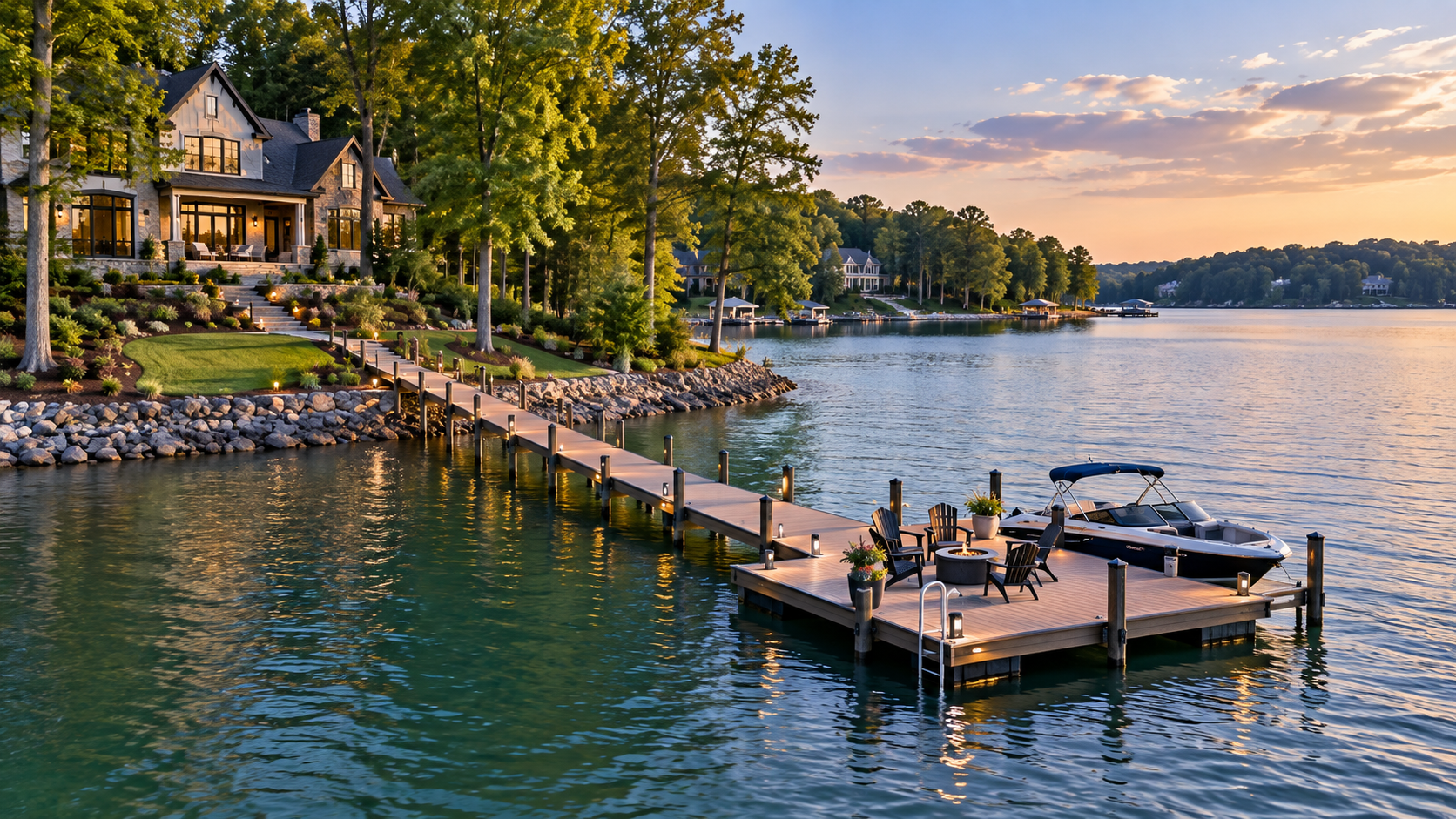
No. Waterfront frontage should never be treated as an automatic guarantee that you can build, expand, replace, or substantially modify a private dock.
This is one of the most important lessons for Lake Wylie buyers.
A listing may say “waterfront,” “dockable,” or describe an existing dock, but those words should be the beginning of your investigation, not the end.
York County's current FAQ, for example, directs buyers and property owners to Duke Energy Lake Management for Lake Wylie dock approval and permitting. The county notes that it does not itself issue the dock permit, although an electrical connection associated with a dock requires county permitting.
So if having a dock is essential to your Lake Wylie dream, make dock verification part of your due diligence before you become emotionally or financially committed to the property.
Questions worth investigating include:
Is the existing dock properly authorized?
Are there records associated with it?
Can it be repaired or replaced if necessary?
Are modifications possible?
Does the shoreline qualify for the type of access you want?
Are there county, environmental, electrical, HOA, or other requirements affecting your plans?
This is where a waterfront purchase differs dramatically from buying a typical suburban house. The feature you care about most may sit outside the four walls of the home.
What Duke Energy Shoreline Rules Should Lake Wylie Buyers Understand?
Lake Wylie buyers should investigate Duke Energy shoreline requirements before assuming they can alter a dock, stabilize a shoreline, or complete other work near the water.
This matters even when the land itself belongs to you.
On the South Carolina side, York County's current zoning code provides a useful example of how local and lake-management requirements can overlap. For Lake Wylie shoreline stabilization, York County requires compliance with Duke Energy's Shoreline Management Guidelines. The county also requires zoning compliance before shoreline stabilization work or obtaining a Duke Energy permit, and certain projects may require a land-disturbance permit.
In other words, there can be more than one approval layer.
That is why I encourage buyers to think beyond, “Can I live with the shoreline as it looks today?”
Instead, ask:
“If this shoreline needs work five years from now, what am I allowed to do?”
That question can uncover information that matters to your long-term enjoyment and maintenance of the property.

How Should You Evaluate Water Depth, Cove Location, and Shoreline?
The quality of waterfront depends heavily on how you intend to use it. Deep water, protected coves, broad views, quieter water, and convenient boating access each offer different advantages.
A buyer who owns a larger boat may evaluate a property differently from someone whose perfect morning involves launching a kayak from shore.
When touring a Lake Wylie home, look beyond the view from the deck. Walk the property toward the water. Examine the slope. Look at the shoreline. Evaluate the dock's condition. Ask about water access and observe surrounding boating activity.
If boating is a priority, investigate whether your boat and intended use are practical for that specific property rather than assuming “waterfront” answers the question.
A protected cove might offer quieter conditions and less passing boat traffic. A more open location might offer expansive views but expose the property to different wake and activity conditions.
The best waterfront is not necessarily the biggest view. It is the waterfront that matches how you actually plan to live.
Do You Need Flood Insurance When Buying Waterfront on Lake Wylie?
Owning waterfront property does not automatically mean the home itself is in a FEMA Special Flood Hazard Area, so flood risk needs to be checked property by property.
This distinction is important.
According to FEMA, the mandatory flood-insurance purchase requirement applies to buildings with federally backed mortgages when those buildings are located in Special Flood Hazard Areas.
Notice the focus on the building's location, not simply whether the parcel touches water.
That means you should review the current flood information for the specific Lake Wylie home you are considering. Depending on the property, part of a lot may have different flood characteristics from the home itself.
Even when flood insurance is not mandatory, it can still be worth discussing flood exposure and optional coverage with a qualified insurance professional.
I also recommend getting insurance information before the end of your due-diligence period, rather than discovering an unexpected cost shortly before closing.
What Should You Know About Septic, Sewer, Wells, and Utilities?
Never assume that two Lake Wylie waterfront homes have the same utility setup simply because they are in the same general area.
Depending on location, a property may involve public utilities, private systems, or some combination.
Septic deserves particular attention on waterfront property. Buyers should determine whether the home uses septic, locate available permit records, understand the system's capacity and condition, and investigate where the system and repair area are located.
For example, Gaston County Environmental Health maintains permitting and records for onsite wastewater systems and requires permits and approvals for new septic installations and repairs.
Why does this matter?
Because your future plans might depend on it. If you dream of adding bedrooms, expanding the home, installing a pool, or changing the property's footprint, septic capacity and available land can become important considerations.
Ask the same questions about wells, sewer connections, irrigation systems, dock electricity, and other utilities.
Waterfront buyers should investigate the entire property infrastructure, not simply whether the faucets work during inspection.
What Should You Inspect Beyond the House When Buying Lake Wylie Waterfront?
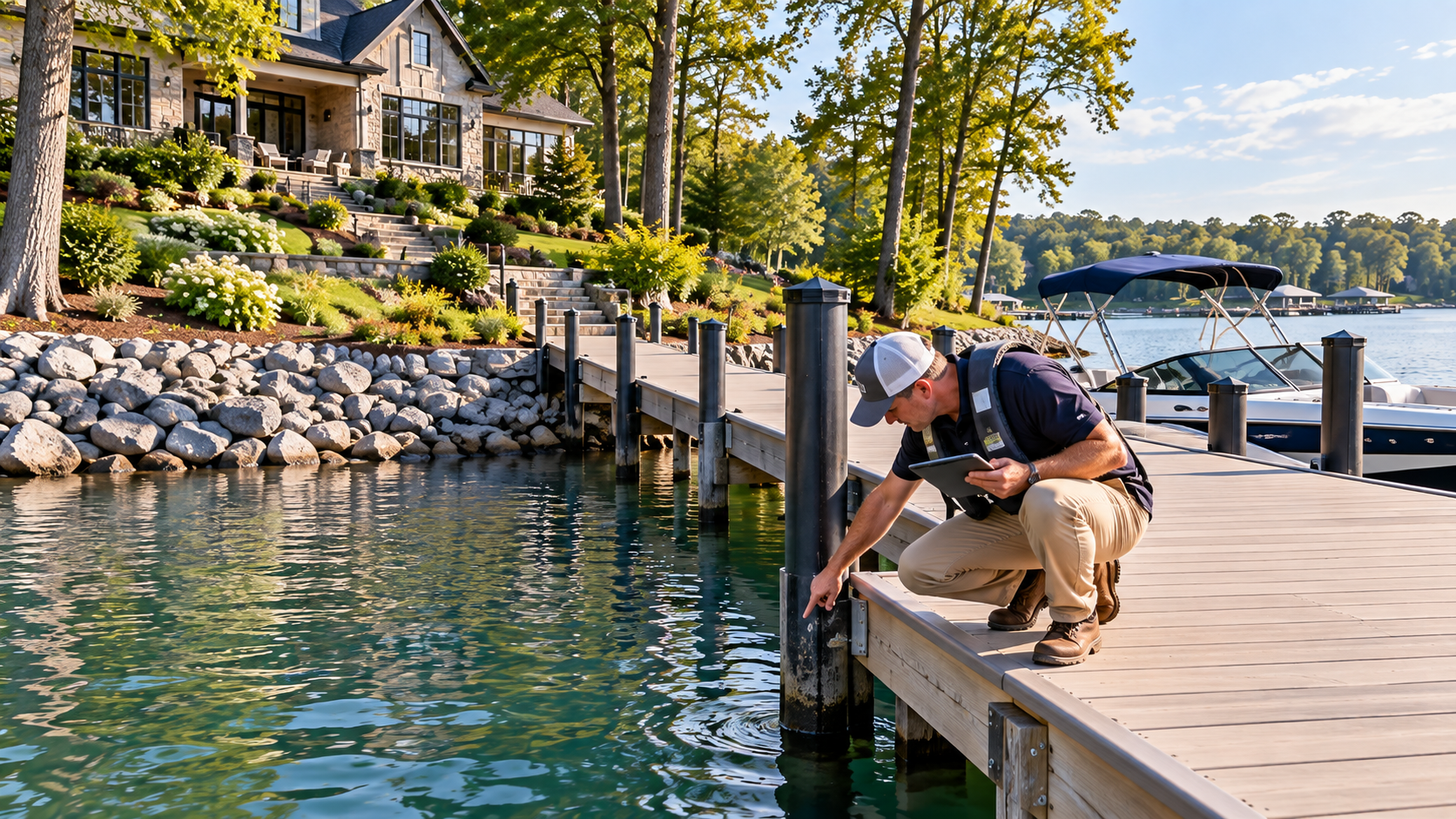
A strong Lake Wylie inspection strategy should include the improvements and conditions that make the property waterfront, not just the home's interior systems.
Your standard home inspection remains important, but depending on the property, additional evaluation may be appropriate.
Pay particular attention to:
Dock structure and visible condition
Electrical service at the dock
Seawalls, riprap, or other shoreline stabilization
Retaining walls
Drainage and erosion
Steps, paths, decks, and structures leading toward the water
Septic and well systems where applicable
Trees or vegetation affecting shoreline areas
Property boundaries and surveys
HOA restrictions where applicable
Flood-zone information
Existing permits, approvals, and documentation
There is a simple reason for being thorough.
Waterfront features can be expensive features.
Discovering a problem with a dishwasher after closing is frustrating. Discovering a significant issue involving the shoreline, dock, retaining structure, or wastewater system can be a much larger problem.
What Boating Rules Should Lake Wylie Homeowners Know?
Lake Wylie homeowners should understand rules on both sides of the state line because North Carolina and South Carolina boating requirements are not identical in every situation.
According to the Lake Wylie Marine Commission, boats generally cannot operate above idle speed within 50 feet of specified private docks, piers, people in the water, and similar areas. North Carolina also requires idle speed within 50 yards of public docks on Lake Wylie.
The PWC rules provide an especially clear example of the cross-border difference. Current Lake Wylie Marine Commission guidance lists a 100-foot idle-speed distance for PWCs around specified people and structures on the North Carolina side, subject to a narrow-channel provision, while South Carolina's listed distance is 50 feet.
Why include boating regulations in a home-buying discussion?
Because waterfront ownership is partly about what happens outside your property lines.
Boat traffic, wakes, nearby public access, cove configuration, and surrounding recreational activity can affect how the property feels on a summer weekend.
If possible, visit a waterfront property more than once and at different times. A quiet Tuesday morning does not always tell you what Saturday afternoon will feel like.
How Can an AI Certified Real Estate Agent Help With a Lake Wylie Waterfront Search?
An AI Certified real estate agent can use modern tools to make a complex waterfront search more organized and efficient while keeping professional judgment and local due diligence at the center of the process.
That distinction matters. AI should support the work, not replace the professionals responsible for inspections, surveys, permitting decisions, insurance advice, legal guidance, or lending.
For a Lake Wylie search, AI-supported workflows can help organize property criteria, compare large amounts of listing information, identify questions that require follow-up, improve communication, and streamline research.
For sellers, AI tools can also support digital marketing workflows, content creation, listing promotion, and audience-focused messaging.
But when you are deciding whether a particular dock is permitted, whether a septic system can support an addition, or how a regulation applies to your property, the answer should come from the appropriate authority or qualified professional.
Technology can make the process faster and more organized. Human expertise still makes the decisions meaningful.
What Should You Verify Before Making an Offer on Lake Wylie Waterfront Property?
Before making an offer, build your Lake Wylie waterfront checklist around the things that would materially change your decision to buy.
For many buyers, that means verifying:
State, county, and jurisdiction for the property.
Primary versus second-home tax treatment where applicable.
Dock status and documentation.
Shoreline restrictions and future improvement possibilities.
Water access and suitability for your boat or recreational plans.
Flood-zone information and insurance availability.
Septic, sewer, well, and utility details.
Survey and property-boundary information.
HOA or community restrictions.
Condition of docks, retaining structures, shoreline stabilization, and other waterfront improvements.
Your commute and access to everyday services.
How the property feels during actual boating activity, not just during a quiet showing.
This is where slowing down can actually help you move forward with more confidence.
The goal is not to make waterfront buying feel complicated. The goal is to uncover the complexity before it becomes your problem.
Buying Lake Wylie Waterfront With Confidence
Buying a waterfront home on Lake Wylie can give you something a conventional home simply cannot: the ability to walk out your door and make the lake part of everyday life.
But that lifestyle comes with additional questions.
The NC-versus-SC decision is only the beginning. The smartest buyers also investigate the dock, shoreline, water access, flood information, utilities, taxes, inspections, and rules connected to the individual property.
Do that work before closing, and you can spend considerably more time thinking about your first evening on the dock and less time wondering what you overlooked.
Thinking about buying a waterfront home on Lake Wylie? Contact me to talk through what you want from lake life and start identifying properties that fit your goals. Together, we can look beyond the listing photos and ask the questions that matter before you make your move.
Frequently Asked Questions About Buying Waterfront on Lake Wylie
Is it better to live on the NC or SC side of Lake Wylie?
There is no universally better side of Lake Wylie. The right choice depends on your commute, preferred community, intended property use, tax situation, schools or services important to you, and the characteristics of the individual waterfront property. Compare actual properties and ownership costs rather than choosing based on the state line alone.
Can you build a private dock on any Lake Wylie waterfront lot?
No. Waterfront frontage should not be interpreted as automatic permission to construct a private dock. Dock approval and shoreline requirements should be investigated with Duke Energy and any applicable local authorities before buying if a dock is important to you. York County, for example, specifically directs Lake Wylie property owners to Duke Energy Lake Management for dock approval and permitting.
Who controls the shoreline on Lake Wylie?
Lake Wylie shoreline activities can involve Duke Energy's shoreline-management requirements along with state, county, environmental, HOA, or other applicable requirements. The exact approvals depend on the project and location. Buyers planning a dock, shoreline stabilization, or other waterfront improvements should verify requirements before assuming work is allowed.
Do you need flood insurance for a Lake Wylie waterfront home?
Not necessarily. Waterfront location by itself does not determine whether federally required flood insurance applies. FEMA's mandatory purchase requirement generally applies to buildings with federally backed mortgages located in Special Flood Hazard Areas. Buyers should check the specific building and current flood information and discuss coverage with their lender and insurance professional.
What should I check before buying a waterfront home on Lake Wylie?
Start with the dock and shoreline documentation, water access, flood information, utilities, septic or sewer system, property boundaries, waterfront structures, HOA restrictions, taxes, and insurance. You should also investigate whether your future plans for the property are compatible with shoreline and local requirements. A waterfront-specific due-diligence checklist can help you identify these issues before closing.
Sources
Duke Energy, Lakes & Recreation and shoreline-management information.
North Carolina Department of Revenue, Property Tax Division.
York County, South Carolina, Homeowner's Guide and Planning & Development guidance.
York County Zoning Code, Lake Wylie shoreline stabilization requirements.
Federal Emergency Management Agency, National Flood Insurance Program guidance.
Lake Wylie Marine Commission, Laws & Regulations and No Wake Zone guidance.
Gaston County Environmental Health, On-Site Wastewater and Wells.


